Bernoulli's Principle & Scientific Background Research
A deep-dive on Bernoulli's Principle - experimental setup, fluid dynamics theory, why the classic blowing-paper demo relates to viscous entrainment and Coandă effect, and engineering applications in aviation.
Overview
This Research is About Bernoulli’s Principle and his Scientific Background and History made by Asaad Zein as a researcher in aerospace minds club and this weak of research is about “If you hold two sheets of paper and blow gently between them, why do they pull together instead of pushing apart? (Bernoulli’s Principle)”
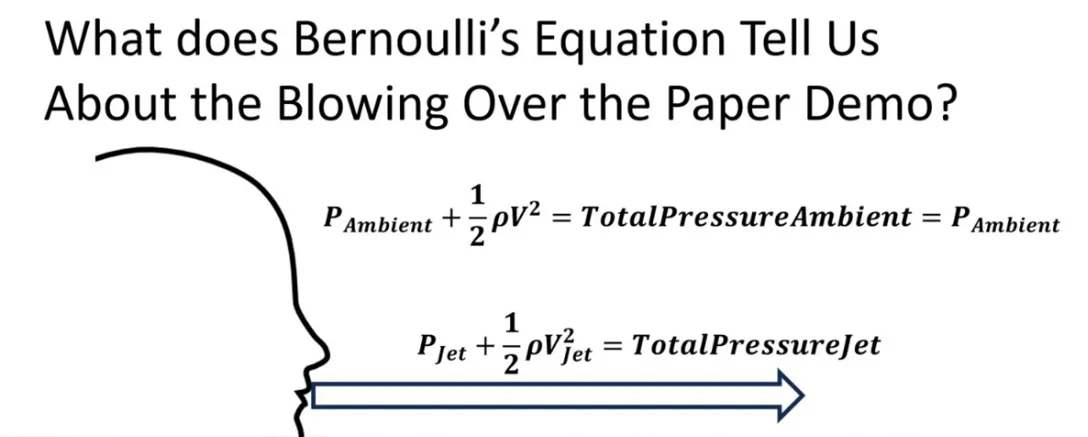
Bernoulli’s principle:
Bernoulli’s principle is a law of physical science that explains the relationship between a fluid’s pressure and velocity. The word fluid may refer to either a liquid or a gas. When the velocity of a fluid increases, its pressure decreases. Conversely, when the velocity of a fluid decreases, its pressure increases. Developed by Swiss scientist Daniel Bernoulli who published it in his book Hydrodynamica in 1738, this principle is readily observable in many real-world scenarios and has many practical applications. Most notably, the Bernoulli principle is an underlying concept in the science of flight. Moreover, the discovery of Bernoulli’s principle was essential to the emergence of hydrodynamics, or the science of the motion of fluids, as a unique field of study.
Bernoulli’s principle states that an increase in the speed of a fluid occurs simultaneously with a decrease in pressure or a decrease in the fluid’s potential energy. Although Bernoulli discovered that pressure decreases when the flow speed increases, it was actually Leonhard Euler who created Bernoulli’s equation that we use today in 1752.
Bernoulli’s principle can be derived from the principle of conservation of energy. This states in a steady flow, the sum of all forms of energy in a fluid will be the same at all points of that streamline. While all the energy remains constant, an increase in the speed of the fluid will imply there is an increase in the dynamic pressure (kinetic energy). This happens with a simultaneous decrease in the potential energy including the static pressure and internal energy.
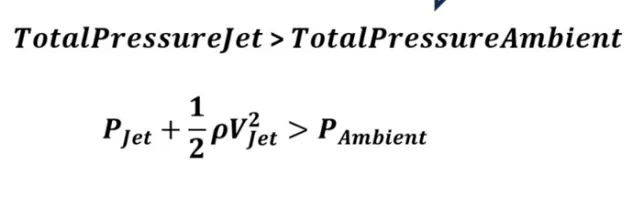
Bernoulli’s Equation in Aerodynamics
For incompressible, inviscid, and steady flow at a constant elevation (z₁ = z₂), the relationship between static pressure and dynamic pressure along a streamline is expressed as:
p + (1/2)ρ v^2 = p_0 (Total Pressure / Constant)
Where:
p= Static pressure (Pa)- $ρ$ = Fluid density ($kg/m^3$)
v= Flow velocity ($m/s$)(1/2)ρ v² = Dynamic pressure (Pa)p_0= Total (stagnation) pressure (Pa, constant along a streamline)
In this form, as the local flow velocity (v) increases, dynamic pressure increases, forcing static pressure (p) to decrease to maintain a constant total pressure (p_0).
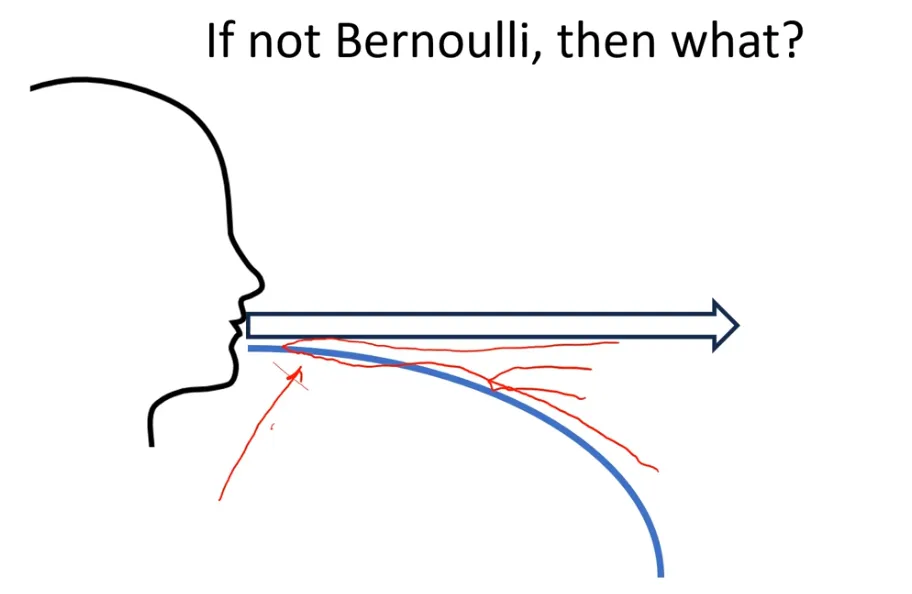
https://www.youtube.com/watch?v=JR-L2CS8DGc https://www.youtube.com/watch?v=mtwTOdEQ0P0 https://www.youtube.com/watch?v=XHeoQ0F6hYc